Showing posts with label the walking dead. Show all posts

Friday, April 8, 2016

Hero to Villain: The Journey of Rick Grimes Continues

Last August, before the start of the sixth season, I wrote a piece concerning whether or not Rick Grimes had become a villain using the definition created by Chuck Klosterman in his book, I Wear the Black Hat.  According to Klosterman a villain is someone who knows the most, but cares the least.  Using that interpretation I went with yes.  Or, at least, “yeah, kinda”.  He had gone from a man who knew little of what was happening in the world, but was deeply disturbed by it, to a man who’d seen way too much and no longer cared about those around him (outside his core group, but even then he would disregard their feelings and thoughts in favor of his own).  I ended on a note of hope that Rick could change, go back to the more heroic guy he once was.


So, with a season passed, has anything changed?  Has Rick been redeemed in the arms of Alexandria?  A little, perhaps, but not really.  While he’s certainly getting along better with others, managed to see the Alexandrians as his people, it took some extreme events to have that happen and he’s generally not any kinder or gentler to those he still considers not “his people”.  The biggest difference, really, is that those around him have (mostly) stopped opposing him.  The original Alexandria citizens have stopped questioning him; when he says “this is how it has to be”, that is how it has to be.  Nowadays Rick might not be considered a villain only because everyone else is just as bad…or there’s someone who’s worse, who knows more and cares even less, like Negan and his Saviors.

Speaking of Negan and The Saviors, they are probably the best comparison to make in showing how Rick is both still a villain and, kind of, a hero...

Negan and The Saviors are a group that “offer” surrounding communities protection from Walkers and other potential threats (presumably like The Wolves) in exchange for food, weapons, and pretty much whatever else they want.  The catch, of course, is that there is no option of refusal.  If a community declines the Saviors attack until they fold and accept the deal or are destroyed.  Even the initial offer comes with a pretty high price as The Saviors are known for introducing themselves by killing a member of the other group in front of everyone.  It is, pretty much, extortion.  A villainous act by definition and obviously not the way Rick and The Alexandrians work, but there are numerous similarities between Rick’s and Negan’s people nevertheless.

Though unplanned, upon meeting those at the Hilltop Colony Rick does end up killing one of them in front of everyone else.  While the act shocks and horrifies those at Hilltop, Rick simply stands up, covered in the man’s blood, looks around, and asks, “What?”.  Even the closest combat and bloodiest murders don’t phase Rick and he doesn’t get why it might bother others.  It was an unfortunate incident, but a justified one, one that had to occur, by Rick’s standards.  And those who rush to defend their fallen community member?  They’re met with guns from Rick and nearly all of his people…it’s Jesus, the seeming behind-the-scenes leader of Hilltop, who ends up having to intervene to prevent further violence.  Intentional or not Negan and Rick’s groups essentially make the same intimidating first impression to their neighboring community.

The deal Maggie negotiates with Hilltop’s leader, Gregory, is basically the same one he made with The Saviors as well.  Protection for supplies.  Rick and his group will kill off Negan and The Saviors in exchange for half of everything Hilltop has.  Now it’s possible that this was setup as a onetime deal, unlike The Saviors’ “subscription plan”, but that seems unlikely...both communities acknowledge Alexandria has little else to offer the Hilltop Colony.  Assuming killing off Negan and The Saviors worked Alexandria would no doubt still want to trade with Hilltop, but would still only have their protection services to provide so, really, Gregory simply replaced one muscle-for-hire with another.  

There are also a few, slightly unnerving, subtleties that point to Rick and the group’s darker tendencies while they’re at Hilltop.  When Gregory initially seems disinterested in doing business Rick tells Jesus that they came all the way there and weren’t about to leave empty handed...something that can be seen as a threat.  I also found it interesting that as Rick’s crew packs up their payment — they apparently got at least a substantial portion, if not all of it, up front — Jesus comments that not even The Saviors took so much straight off.  These two details, combined with the rest of the initial meeting of Alexandrians and Hilltops, show how closely Rick and his people mirror Negan and his.

How Rick chooses to address The Saviors is infinitely clearer in its villainy…So much so there isn’t really much way to defend it.  Based mainly on the word of Hilltop and a single run-in by Daryl, Abraham, and Sasha it’s decided that everyone in Negan’s crew have to be eliminated.  Rick goes to Alexandria’s people, his people, with the explanation that they have to hit first and “kill them all” to be safe; an echo of what The Governor said concerning Rick’s group back at the prison.  Their exact plan is to trick and force their way into a compound where The Saviors reside and systematically kill them in their sleep.  It’s a pretty brutal way to deal with another group, no matter who they are.

When Maggie and Carol are taken by a small group of Saviors one of them, ‘Chelle, tells Maggie: “You’re not the good guys.  You should know that”.  She’s completely right, especially in that moment.  If you view the events from the perspective of The Saviors, Rick and the rest are absolutely the villains.  Unprovoked, they creep into a residence of The Saviors and murder them in their sleep, then ransack the place.  This viciousness continues even after Maggie and Carol escape when, instead of just leaving, they kill those holding them then lie in wait for their backup to kill all of those Saviors as well.

For most of season 6 it seems like Rick is still the person who knows the most and cares the least; he’s got the drop on Negan and The Saviors and he uses it to slaughter Saviors in their sleep.  He does this without a second thought or consideration for the defenseless nature of those within the compound.  Afterwards he’s confident to the point of arrogance as he relaxes and basks in a new relationship sure that he and his people can handle anything.  He’s seen nearly shirking off preparations for a potential attack, clearly unworried that he might be in over his head.  So then what, exactly, might make Rick still a hero?  The arrival of Negan, mostly.  

Negan knows infinitely more than Rick in the end.  He knows more about the area, the communities, and how best to manipulate this new Walker-filled world to his advantage as his success over Rick (and others) shows.  Negan appears to know a great deal about Rick’s group, certainly more than Rick knew about The Saviors.  More importantly, Negan revels in that knowledge, seemingly delighting in watching Rick and his group’s world crumble before their very eyes.  He enjoys knowing the most, but also clearly cares the least...almost to the point of being sadistic in his torments of Rick’s group both in the buildup to and actual face-to-face meeting.  Rick did some terrible things, he didn’t care, but he wasn’t exactly having a party while doing them...Negan is though.


In truth I’m not sure Rick will ever go back to that truly heroic man he once was; this world seems unwilling, unable, to allow that for him.  I’m not sure the Walker-filled world will allow that for anyone in the end, though I root for the holdouts…those that, no matter how much they know, still care deeply.  Those like Morgan, Glenn, and Tara (who cringed at Rick's "kill them all" declaration and remained unsure throughout their attack on The Saviors).  As far as Rick?  The best that can be hoped for is that he never becomes the worst out there, but that’s not a hope to root for either because, in the end, those are the people Rick and the rest for will no doubt have to deal with.

Friday, April 1, 2016

Who's About to Die on The Walking Dead??

Obviously, as of this moment, the biggest question on every The Walking Dead fan’s lips is:  Who’s going to get the business end of Lucille, Negan’s beloved barbwire-wrapped bat?  The second biggest question is: Who else could die?  Given how the latest episode ended there are plenty of possibilities, some are more likely than others.  Let’s run them down:

Glenn


He died via Negan’s beloved barbwire-wrapped bat in the comics, but nothing that’s occurred the comics has happened exactly the same way on the show yet.  This is a good thing for beloved supply-runner extraordinaire.  Yet, nothing says the show will never lift big moments direct from the comics either and Glenn is currently in the hands of Negan’s man, Dwight.  My own guess?  He’ll be fine for a while longer…at least long enough to find out about whatever’s happened to Maggie and their baby.

Daryl


Initially a top pick by some, his likelihood has actually gone down since his last run-in with Dwight.  At least on being Negan’s victim; it’s not terribly impressive or threatening to beat a guy who’s already been shot to death.  It doesn’t send the message Negan no doubt wants to send to Rick and the rest.  Now it’s possible Daryl will still die even with Dwight saying “you’ll be alright”.  First because Dwight might not be talking to Daryl and, second, it’d be a potential mirroring of Carol’s “non-fatal” shooting of Savior Donny, who ultimately succumbed to his wounds.  (The Walking Dead’s been loving the mirroring stuff lately.)  Also actor Norman Reedus, who plays Daryl, showing up on The Talking Dead aftershow increases likelihood of death.  …All that said, I’m still leaning towards a “you’ll be alright” for Mr Dixon.

Rick


Yeah, not gonna happen.  Sure, it’d get Negan’s message across in surround sound and technicolor, but Rick’ll be fine.  This is an ensemble show, sure, but the story still heavily favors Rick and his experiences.

Carl


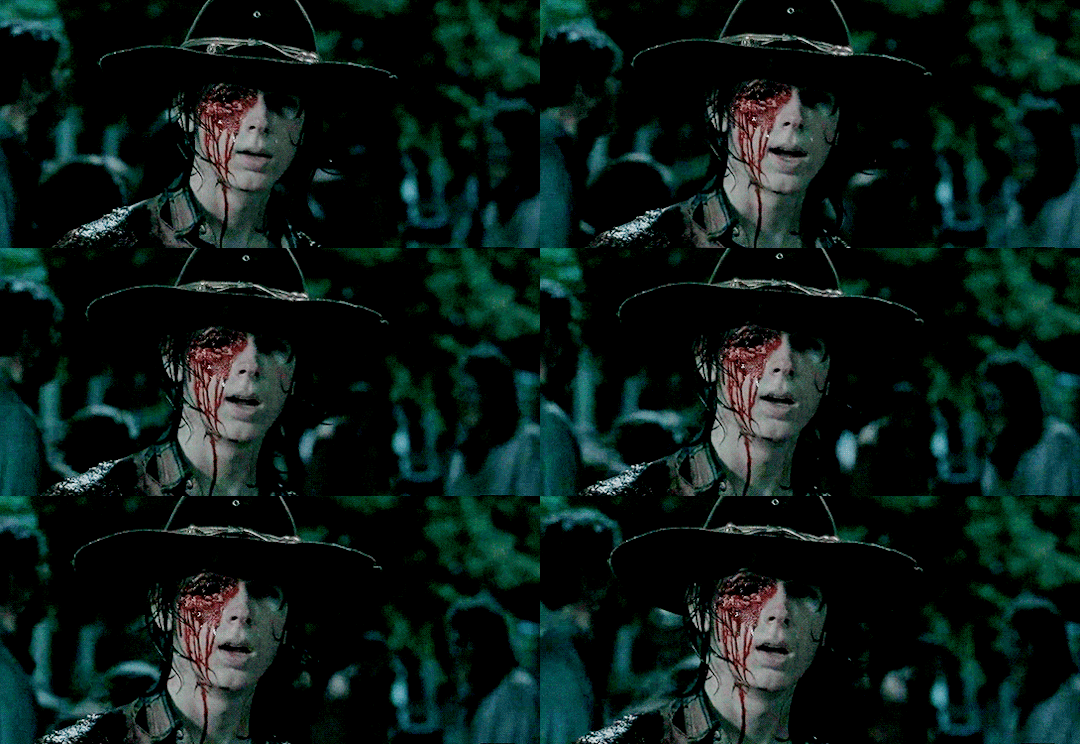
Same as Rick…also he’s still, technically, a kid.  True, Negan beat a sixteen-year-old to death at Hilltop to make his “I own you people” point, but Carl’s younger than that on the show.  Also he’s got one eye, seems hugely unfair to attack him in my opinion.

Michonne


It’s possible.  Like Glenn and Daryl she’s being held by Dwight’s men, which immediately puts her in the proverbial crosshairs.  It’d make a huge impact (heh, pun not intended this time) on the group and the show on whole, which is exactly what Negan’s killing/this particular death is supposed to be.  …And, of course, Rick already doesn’t have the best track-record in love - he loves them, they die.  It probably still won’t happen, it’s likely too big a risk for the show to take, but I’m not about to rule it out.

Carol


Carol’s a maybe.  She took down that smaller group of Saviors, but that’s the last we saw of her.  With Saviors running all over the area it wouldn’t be too far-fetched if she met up with more of them…too many for even her to take out all alone.  That aside Carol’s begun to unravel with all the murders she’s committed and she could become reckless with her own well-being.  Some have also pointed out that Carol’s story could be done with her newfound discomfort with violence, which primes her to go out as still a badass.  Whether by Negan’s bat or some other conflict it’s a real possibility.

Morgan


He does have that Savior heading in his direction that he’s unaware and probably unprepared for.  For most others on the show this wouldn’t be an issue - they’d kill the lone Savior with the gun and keep going - but Morgan’s still steadfastly against murder.  It’s more likely that the Savior would just kill Morgan, not bring him back to Negan, assuming the guy is physically able to given the shape he’s in.  What would be truly interesting is if Morgan ultimately kills him in a scuffle over the gun Rick gave him…otherwise, if Morgan sticks to not killing people, he’s high on the list of meeting an unpleasant end at the hands of that surviving Savior.

Abraham


Probably.  Most likely.  Sad to say, but he’s got a lot of points in the “could die” tally.  First and foremost, he’s out with Rick in the main promo so that ups the chances right there.  Then there’s the fact that he’s a big guy, one of the group’s heavy-hitters (sorry, the puns write themselves!), so killing him in front of Rick et all would certainly get Negan’s message of dominance across.  Abraham’s loss would be deeply upsetting all around - he’s a good portion of comic relief after all - but not exactly “if [he] dies, we riot” upsetting.  There’s also the fact that he’s hopefully starting a new relationship (not just a bad sign for Rick) and it’s been shown that his BFF, Eugene, can almost survive without him.  Speaking of Eugene, he might actually be another reason Abraham’s likely to get the bat: like with the comics, one half of a key “couple” will be forced to watch the other be brutally killed, only on the show it would be a bromance couple.  My money’s on Abraham getting up close and personal with Negan’s Lucille.

Eugene


Probably not.  He’s out with Rick in the promo, which ups his chances, but there’s little payoff in killing him.  He’s not a key guy in the group or with audiences.  The truth is he’s just starting to blossom into his own man, his own character, and if the show’s smart they’ll explore it more before ending him.  Also, even with recent growth, he’s still the type to be freaking out (crying, shaking, wetting himself) at Negan and I don’t see Negan taking out a guy who’s already terrified of him.

Aaron


The only reason I’m even considering Alexandria’s recruiter is because he was shown with the rest of Rick’s ragtag team in the promo.  It’s deeply unlikely it’ll be him.  He’s not a key enough character, he’s not a tough guy, and, like Eugene, will probably also already be properly afraid of Lady-Bat Lucille.  …Also, unless The Walking Dead team wants a mass of fans pissed about killing yet another LGBT character back-to-back, they’ll wisely leave Aaron mentally scarred, but otherwise unharmed.

Rosita


Since she’s in the Dwight’s captive crew there’s a possibility, but not a big one.  Like Eugene, she’s mostly still just a secondary character and while her death might upset the group it probably wouldn’t traumatize them.  I mean, she’s a cool chick, but, ya know, they’d get over it within a couple weeks…even Abraham and Eugene.  As far as the audience?  Same.  They’d be upset, yeah, but by the time the show returned for Season 7 they’d be all “oh, yeah, I forgot about that”…Negan needs to make a bigger first impression than that.

Maggie


Via Negan?  Nope, don’t see it.  Sure, some Saviors could snatch her (and Enid?) in route to Hilltop’s doc, but that seems awfully convoluted given all the people Negan’ll likely already have to chose from between Dwight’s captives and Rick’s motley crew from the promo.  Via something else?  Maybe.  It’d be a major loss for the group and the audience and a truly unexpected one given everyone’s focused on who Negan’s going to kill.  There’d also be something truly intriguing and tragic about having Glenn survive over and over only to lose his wife (and child) so unexpectedly…then have to find a reason to keep carrying on.  The question is whether or not the show’s brave enough to make that choice and it’s sort of hard to tell.

Judith


She’s an infant, so no.  I mean there might be some cosmic writing mishap that gets her killed by some other means, but…nah…nevermind…she’s not going to die.  I’m 99% sure she’ll stay alive until the end of the show itself so the writers have a way to explore raising a baby from birth in the Walker apocalypse.

Baby Gleggie


Because we already have a baby to raise in the Walker apocalypse we really don’t need another.  Sorry, little Gleggie, we hardly knew ye, but even if mother lives, you’re probably going to die.

Father Gabriel


From a sneak peak provided by The Talking Dead we saw that he’ll be watching over Alexandria in general and Judith specifically so he could die.  It’s super unlikely - no one would really care if he did, for one - but if Saviors came to Alexandria he could totally die protecting Judith and others.  …But, again, who would care?

Sasha


Not even sure where she is right now.  Was she staying behind to watch over Alexandria and baby Judith with Father Gabriel?  I think so.  Will she die?  I think no. 

Enid


No.  No one would care.

Saturday, March 12, 2016

Walker Apocalypse Love

Lately there’s been a lot of coupling going on in the Walker apocalypse.  Maybe it’s that Rick’s people are starting to settle into a fair sense of security or maybe it’s because love and romance always raise the stakes in a TV show…Or maybe it’s just psychosocially accurate.  Over the years there have been studies showing that intense situations and intense conversations can make those around you more attractive.  When someone is keyed up, scared, in fear for their safety and/or life, they fall into attraction more easily and more strongly than when not…basically, when you’re fighting for survival in the apocalypse you’re way more likely to fall in love too.  Simply being close to someone on a near constant basis can also cause attraction, just as being exposed to a person over and over can.  Really, it’s no wonder the characters on The Walking Dead are pairing up like those in an ark.

Scaring Up Some Love:


In 1974 psychologists Donald Dutton and Arthur Aron did an experiment in which they asked men to cross either an unsteady suspension bridge or regular sturdy bridge, then fill out a survey and make up a story based on an illustration of a woman covering her face given by a female on the other side.  The female then gave each man a contact number should they have any other questions.  Those who crossed the fear-inducing suspension bridge called the woman back 50% of the time and were more likely to sexualize their story of the illustration; the guys who crossed the non-fear-inducing sturdy bridge only called 12.5% of the time and their stories were less likely to be sexual.  …Basically the study found if you’re a bit rattled then you’re a bit aroused and thus more likely to make a move should you meet someone.

So how does this translate to Rick and the crew hacking their way through the undead and alive alike?  Think of Rick and Michonne’s first time: Both had been dealing with some intense, potentially dangerous, situations before meeting up at the end of that day…

Rick and Daryl had been out on a supply run most of the day, contending with a previously unknown man called Jesus who stole their truck.  Was Jesus dangerous?  Potentially.  He was certainly a thief who got Rick and Daryl’s hearts pounding and blood boiling as they chased one another around for miles.  Meanwhile Michonne spent the day walking the woods outside Alexandria worrying about Spencer doing something dangerous and ultimately facing off against a Walker Deanna.  While perhaps less physically arousing than Rick’s day it would still be emotionally so.  She would still be keyed up, as it were.  This means, by the end of the day, we’ve got two (now safe enough to not panic) geared up people who have always been comfortable with one another crashing on a couch and wanting to unwind.  It’s honestly not too shocking that their initial platonic touch quickly escalates to intimate on both their parts.

Need another example?  How about Carl and Enid getting super close in that tree?  After hanging out with Enid just outside the walls of Alexandria a fair number of Walkers approach causing them to have to run and hide in a tree.  It’s when they’re relatively safe and well-hidden, but still close enough to danger to make hearts pound, that Carl finally moves to touch her.  (Too bad they didn’t kiss, am I right?)

Baring Your Soul to Bond:


In 1977 those same two psychologists did another experiment concerning attraction…this time they “made” it in a lab.  On the basis of 36 increasingly probing questions they were able to get two people who’d never met before to bond strongly and deeply enough that they wished to meet again outside the experiment.  And Dutton and Aron accomplished it in under an hour.  No matter the genders, races, orientations, or whatnot of the individuals a deep bond was made.  (This was compared to a control group in which pairs were made to ask and answer less emotionally intense questions such as: “What gifts did you receive last Christmas/Hanukkah?  What foreign country would you most like to visit? What attracts you to this place?”)  The experiment itself has been done repeatedly, in various different forms, throughout the years and the results have held true consistently…Aron even stated that in doing a “cross-gendered” version of his experiment the people fell in love, married, and remained so (as of 2008).

How’s this work on The Walking Dead?  Well I don’t think I’d be going out on a limb here to suggest that over the year plus that Rick’s group has been together they’ve shared a lot about themselves with one another.  We know from the latest episode that Tobin knows Carol was a mom, so it’s likely Carol’s discussed the emotionally charged topic of losing Sophia (and maybe the truth about Ed?) even if he initially learned only from watching her Alexandria entry interview.  It’s possible Tobin shared how he lost his family, which I believe included a wife and children.  He also stated he admires that she is still very much a mother figure to those around her, which is both complimentary in a genuine and unusual (for her these days) manner and brushes up against the emotionality of her having been a mother.

In a larger sense all the characters have revealed personal bits and pieces about themselves to one another on-screen, whether it be what they had hoped for pre-apocalypse versus now, their regrets, their losses, what they see (good or bad) in others and how they relate to it.  There have also been examples of characters discovering deeply private things about one another through other means.  While searching for Beth in season five both Carol and Daryl witness sides of one another not previously seen.  One of the potentially most bonding things (though never actually discussed between the two of them) is when Carol sees a book on how to heal from childhood abuse fall from Daryl’s bag.  While Carol’s abuse was never hidden thanks to her husband hitting her in front of the group in season one Daryl always made the effort to hide it - even from his elder brother, Merle.  Carol having this knowledge and Daryl knowing she does could’ve, potentially, made their already close bond ever closer.  (Sadly for the Darol/Caryl fans their romantic potential has not panned out, but you can’t deny they’re still ride-or-die close!)

Close Enough to Care:


Propinquity specifically refers to the physical or psychological proximity between people; it can mean physical proximity, a kinship between people, or a similarity in nature between things (think “birds of a feather”).  Rick’s crew - and nearly any other group on the show - is ALL about ALL the various forms of propinquity.  There are three main forms: Occupational propinquity, which has to do with people working in the same field/job, residential propinquity where people living in the same area or within neighborhoods of each other tend to bond, and acquaintance propinquity when friends tend to have a special bond of interpersonal attraction.

I’ll take on the last first: Acquaintance propinquity is basically the idea behind two besties falling in love.  They already like each other, already hang out together, so take the next seemingly logical step in becoming romantic partners.  It’s Rick and Michonne, even according to Lauren Cohan, who plays Maggie Greene.  When asked on Talking Dead what the rest of the group likely thought about seeing the two as a couple she said it might’ve thrown them for a split second, but then completely made sense.  Like when two of your friends fall in love with each other…it’s an “oh, well, of course they did!”  

Occupational propinquity is the basis for office romances or two artists falling in love.  Their professional lives are very similar and they have the opportunity to meet and bond over what they do for work.  Outside the shared “job” of killing Walkers and surviving there are a few, more specific, examples of this sort of bond/relationship on the show including Abraham and Rosita.  Or, if you’d like, Abraham, Rosita, and Eugene.  The trio all entered the show with a strong bond based on the shared mission of getting Eugene to DC in order to stop the Walker-causing virus.  Even after Eugene revealed he’d lied and the mission went bust they remained almost inseparable.  While Abraham has somewhat parted from this bond it is in no small part because of another instance of occupational propinquity: he and Sasha got close while leading a section of the mega herd from Alexandria (and surviving ambushes by the Saviors).

The third propinquity is residential, which explains almost everyone’s relationship on the show since the apocalypse.  Those within communities such as Alexandria and Hilltop pairing off would shock no one given they see each other every day just as anyone in a pre-apocalypse neighborhood might.  The same holds for Rick’s group as some of them have been side-by-side, every day, for more than a year.  While to start many in Rick’s group had no discernible reason to even get along — Daryl was a “redneck” who initially arrived with his brother to rip the group off, Glenn was a scrawny Asian pizza guy, Rick an Alpha male cop, and Carol an abused housewife — now they’re all a family.  A great deal of that is likely the result of having lived together for so long.

A more generalized concept of propinquity is the familiarity principle, a.k.a. the exposure effect, which states that being repeatedly exposed to something - or in this case some one - makes one more likely to like the thing or person.  An example would be not being sure about a new song, but after listening to it a few more times deciding it’s quite a catchy tune.  For a social example think about meeting someone new at school/work/through a mutual friend and then, after running into them a few more times, you find they’re actually pretty funny and cool to hang out with.  It doesn’t always happen, of course, but tends to more than not.  And it explains why, over the last episode or two, Rick and Daryl have warmed up to Jesus…they’re getting used to him the more they spend time with him. 

Mix and Make Relationships:


Of course, it’s never just one of these influences that creates a relationship - not in everyday life and not in the Walker apocalypse - but they all work together to aid in the growth and development of bonds between people.  They explain how people who might otherwise never  even meet would form bonds stronger than those of blood relations in a post-apocalyptic world such as that shown in The Walking Dead.  It explains most of the relationships on the show and why some fan-favorite “ships” totally make sense even if they haven’t happened.

Wednesday, December 30, 2015

WHY Tough Women Have Traumatic Pasts...and It's a Problem

In the previous post I described some various ways in which tough women inevitably have traumatic pasts, but so what?  I mean, sure, that’s strange and all, but there are lots of tropes out there in the pop culture world.  True...but not all of them indicate a key issue that still plagues the world of entertainment and beyond.  Inequality.

While strong men may have tragic backstories they don’t have to and, honestly, usually don’t in the end.  Women pretty much have to.  There are precious few female characters that kick ass and take names without first having been through some of the worst experiences imaginable - loss of family, assault, sexual abuse, kidnapping, rape, attempted murder.  Men are frequently portrayed as capable of surviving in harsh, even post-apocalyptic, environments without really having gone through much beforehand while surviving for women seems to have to be old-hat with the worst having happened to them long before the world fell. 

Not all portrayals of this inequality are the same, but all ultimately lessen the strength, the toughness, of the female character.

What a Strong Woman!

On the surface there’s nothing wrong with strong women.  They’re great!  It’s important, crucial even, to show that women can match their male counterparts in inner and outer strength.  That women can overcome adversities, even terrible ones, and they can be all the tougher for it.  In certain cases overcoming adversities where others might fail shows that they can be even stronger than the men around them.  …That a woman is strong is not the problem; it’s that many are shown primarily as weak first.

When I discussed The Walking Dead’s Carol Peletier and The Silence of the Lamb’s Clarice Starling I pointed out how, first and foremost, these two were introduced as the weak and the abused.  Carol is small-framed, middle-aged, mother with an abusive husband who loses pretty much everything (including her daughter) within the first few weeks of the show's timeline.  Clarice is consistently shown as short, even tiny, compared to her male FBI cadet peers and there’s more than one incident of a man at least attempting to push Clarice around…and then there’s the earlier death of her father and being unable to save those slaughtered lambs.  It’s only over time that their strength is revealed - as they take on greater and greater threats and are able to repeatedly come out on top.

There’s an implication with both women that without the traumas in their life they would not be so strong.  Clarice idolizes her father who was killed in the line of duty and seems to have an underlying goal of making him proud, even becoming like him.  Those lambs she couldn’t save haunt her so now she aims to save others no matter the danger.  Carol only begins to really be someone after her abusive husband is eaten by Walkers.  Only then does she speak and stand up for herself and others.  Carol’s development as strong woman takes on another layer when, after losing her daughter as well, she’s even tougher…becoming (violently) proactive in defending herself and those she cares about.  Women first.  Strong second.

In the end it takes away a bit from the toughness these ladies have.  They are greatly admired (and should be!), but I’ve never heard anyone credit them with just being strong.  It’s always about them being strong women and not just strong.   …It ends up reminiscent of a politer version of “pretty tough…for a girl”.

She’s Not Hard, She’s Just Troubled

Some women onscreen spend most of their time being brusque, callous, and totally unwilling to take anyone’s shit.  They are what’s popularly referred to as the HBIC - Head Bitch in Charge.  Initially no one’s completely sure why they are this way; it seems to just be a matter of personality, but that can’t be right.  Women can’t be so naturally harsh, can they?   Then their past is revealed.  A past filled with pain and humiliation and (almost always) sexual abuse.  Now these women makes sense, their true selves have been discovered…deep down they are just scarred, scared, little girls.

This is essentially what happens to both Ani Bezzerides of True Detective and Claire Underwood of House of Cards.  The women start off as tough characters.  With knife always at the ready Ani is running raids, casually bedding partners, and giving glares and snarky replies to anyone who suggests she tone herself down.  Claire is tough for both her and her husband, doing whatever she deems necessary to advance their careers, even threatening pregnant women, all while keeping a calm demeanor.  They are aggressive, determined, and unmoved by what others think.  Both practically dominate the male-based worlds of law enforcement and politics they are in.  While not always the kindest people they are admirable in their fearlessness and command of others.  …Then their pasts are revealed.  Pasts filled with sexual abuse and feelings of helplessness.

Even more than with the other two (Carol and Clarice) this manner of dealing with traumatic pasts lessens the strength of these women.  Now that the ice queen’s veneer is cracked she can be a woman again.  Just a woman who’s been abused and is afraid of becoming a victim again.  That’s why she’s so aggressive and unwilling to play along, that’s the real reason she’s so tough.  She’s not the cold, calculating, woman in charge, but the girl scared of her next potential attacker.  Their traumatic pasts soften these women, change them into someone (something) more manageable and palatable to audiences - especially the misogynist ones.  

There’s also the sense that the traumatic past was added as an afterthought to explain the women’s aggressive behaviors in these cases.  Whatever toughness they have - which is a great deal - can now easily be dismissed as a reaction to their previous assault.  The women’s actions and reactions run the risk of being taken less seriously once the majority of their behaviors can be linked to a serious past trauma…even the women themselves can, potentially, be taken less seriously.  Again, they aren’t hard individuals that shouldn’t be messed with, but instead troubled women still dealing with what happened to her in her youth.  It becomes hugely unfair to the characters and the audience - Ani and Claire were already multidimensional female characters, why couldn’t they just stay the hardcore badasses they were for the majority of their storylines?

It’s not to say that no female characters should have traumatic pasts, but not all female characters need them either.  When the trauma is used as a cover explanation of or sole reason for the character’s behavior it becomes a problem.  Not everyone who is independent, strong, or even aggressive is that way as a result of an earlier devastation.  Some women, like some men, just kick ass and have always kicked ass.  (Though some men may, in fact, have traumatic pasts and more such men should be represented in pop culture to help fight this sort of gender inequality.)  A traumatic past - whether of a female or male character - should only be part of a characterization and never used as the sole explanation for their personality.